
The Truth About Friction in Weaving and How AAS Tech Solves It

Every time yarn passes through a heald eye, it encounters resistance. In isolation, a single pass is negligible. Across millions of cycles per day, across hundreds of looms running continuously, that resistance compounds into one of the most significant hidden costs in textile manufacturing: friction. AAS Tech has spent decades engineering wire healds, flat healds, and heald assemblies specifically to address this problem — not manage it.
Friction Is Not an Acceptable Variable
Traditional wire healds introduce friction at the heald eye through surface irregularities, suboptimal eye geometry, and single-material construction that prioritises strength over yarn interaction. The result is a component that holds yarn under tension but simultaneously works against it — increasing yarn stress, accelerating breakage rates, and forcing operators to run looms below optimal speeds to avoid cascade failures.
AAS Tech's engineering approach rejects the premise that friction is a variable to be managed with lubrication schedules and operator adjustment. Instead, every heald geometry, surface finish specification, and material selection is oriented around minimising the friction coefficient at the point of yarn contact — by design, not by maintenance.
The AAS Tech Engineering Response
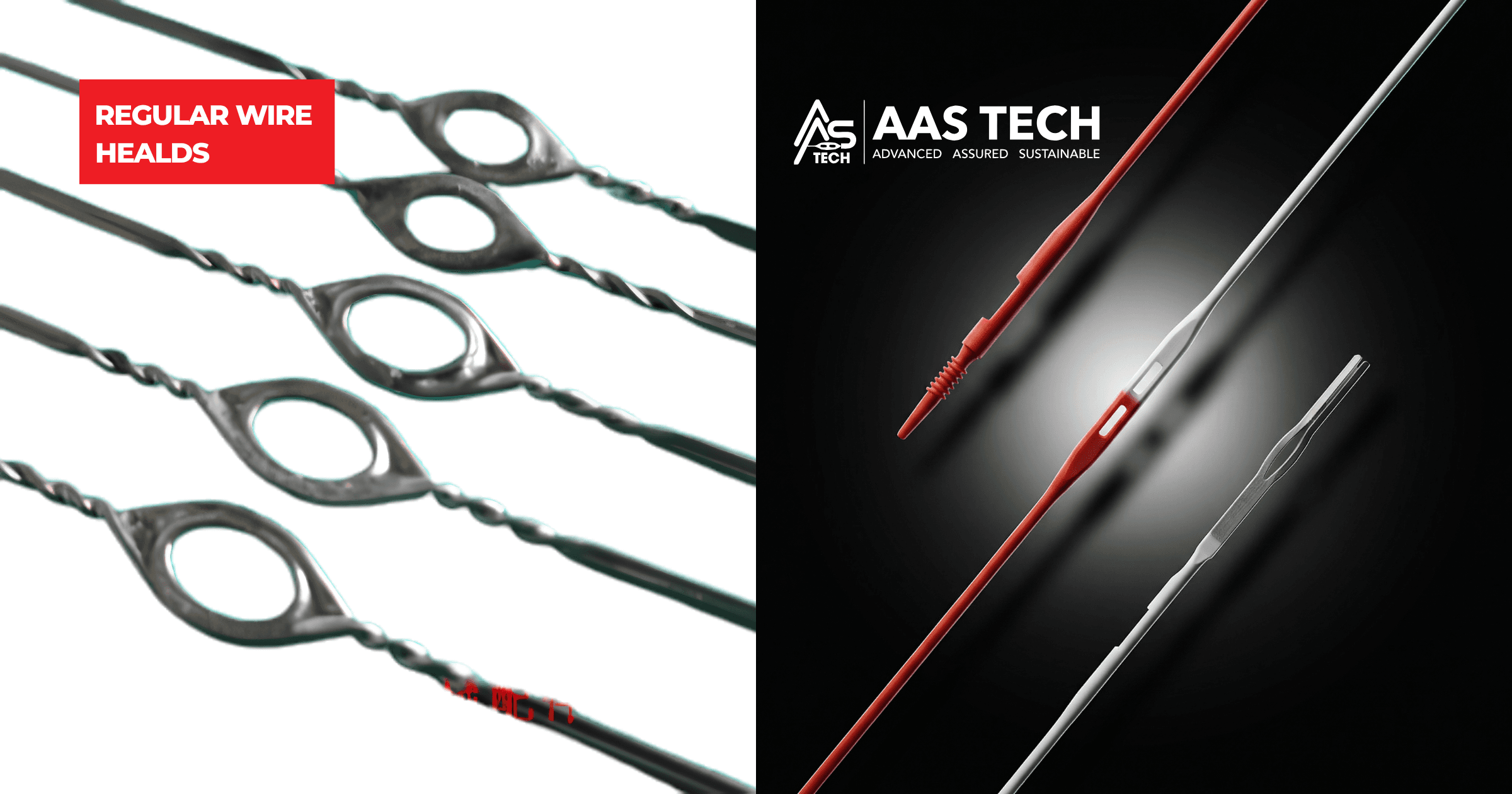
AAS Tech wire healds feature an elliptical dual-eye design that reduces contact surface area while distributing the load across two contact points, limiting stress concentration on the yarn. The polished inner surface — engineered to a specific roughness specification rather than left to manufacturing variability — ensures consistent yarn movement with minimal resistance across the full operational life of the heald.
AAS flat healds take this further with a three-breakpoint contact system that maintains consistent contact pressure against the yarn without creating a gripping effect. The flat heald geometry allows the yarn to pass through with a natural movement arc, reducing the sharp angle changes that generate peak friction loads in conventional round-wire designs.
“Friction in the heald eye is not an engineering inevitability — it is a design failure. Every AAS Tech heald is engineered from first principles to treat friction as the primary problem it solves, not a secondary consideration.”
— AAS Tech Engineering Team
Measurable Outcomes
Mills that have transitioned from conventional healds to AAS Tech wire or flat heald systems report consistent improvements across four key metrics: yarn breakage rate reduction, loom speed increase, heald replacement frequency reduction, and fabric surface quality improvement. These outcomes are not incidental — they are the direct consequence of eliminating the friction variable that conventional heald designs leave unaddressed.
For more information, contact info@aastech.co.
Related Articles
Stay Ahead of the Industry
Subscribe for engineering insights, performance strategies, and AAS Tech innovations delivered to your inbox.