
Regular Wire Healds vs. AAS Wire Healds: Eliminating Friction with Innovation
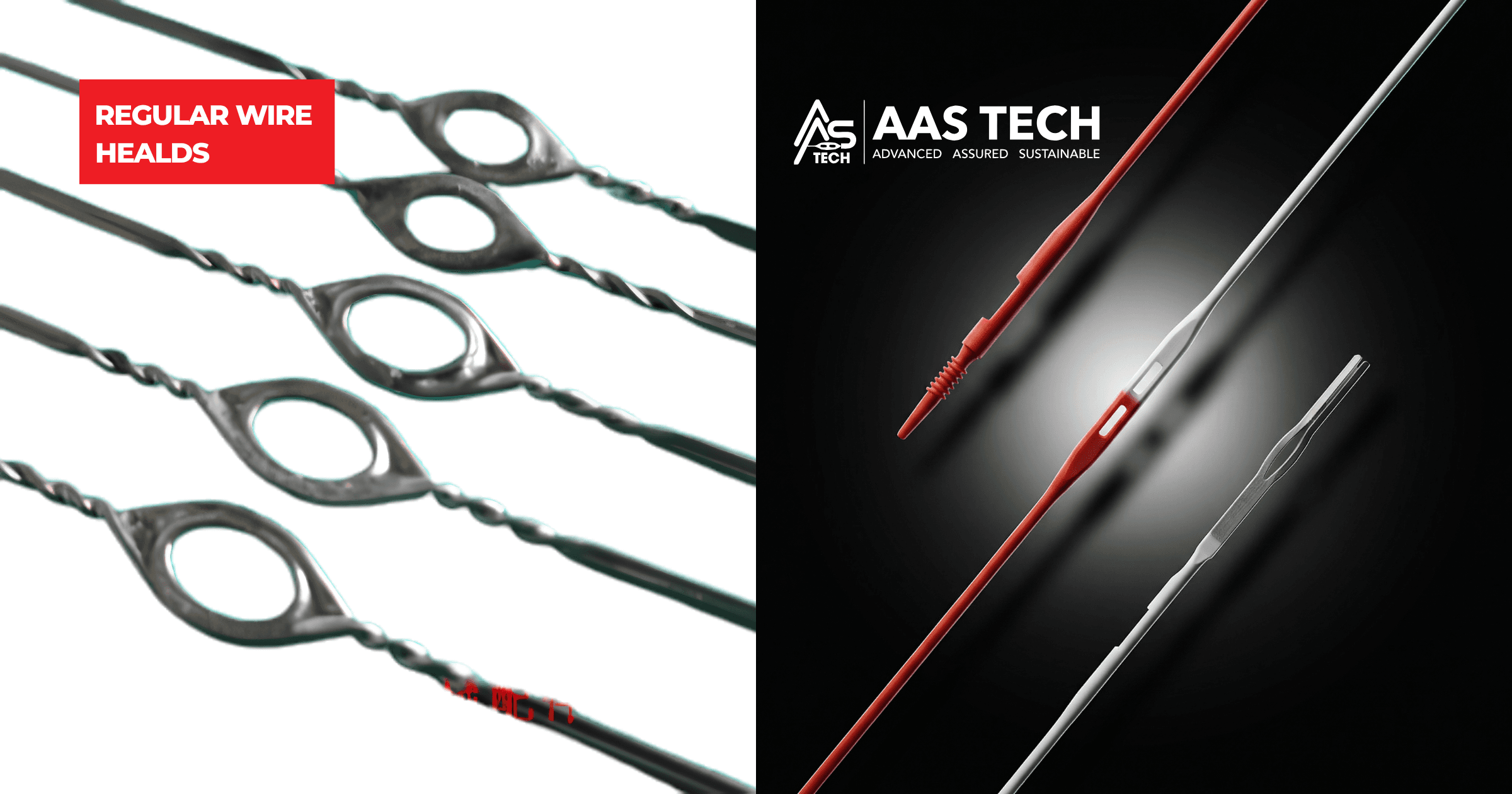
Wire healds are an essential weaving component — one of the most contact-intensive elements in the entire loom system. Yet for decades, conventional wire heald design has prioritised manufacturing simplicity over yarn interaction quality. AAS Tech's approach to wire heald engineering starts from the opposite premise: the yarn is the primary system, and the heald is an instrument in its service.
Surface Finish: The Critical Differentiator
Conventional wire healds are manufactured to a surface finish specification defined by what the production process can achieve, not by what the yarn requires. The result is a heald eye inner surface with a roughness profile that creates microscopic abrasive contacts at every yarn pass. Over millions of cycles, these contacts accumulate into measurable fibre damage, piling, and eventually yarn breakage.
AAS Tech wire healds are manufactured without a parting line — the seam left by conventional die-forming processes that creates a raised ridge on the inner eye surface. This single manufacturing distinction eliminates one of the primary fibre-catch points in conventional heald design. Combined with a controlled surface finish specification, AAS Tech wire healds provide a smooth, consistent contact surface that maintains its friction properties across the operational life of the heald rather than degrading with early wear.
Dual-Material Construction
AAS wire healds feature dual-material construction: a high-strength primary structure that maintains dimensional integrity under high-tension conditions, combined with a secondary material at the yarn contact zone that provides lubrication properties. This combination addresses the fundamental limitation of single-material wire healds — the trade-off between structural strength and friction-reducing surface properties.
Dual-Eye Design
AAS wire healds incorporate a dual-eye geometry that distributes the yarn contact load across two distinct contact points, reducing the peak stress concentration on the yarn at each point. This design allows for higher-density yarn configurations without increasing per-yarn friction loads — enabling mills to increase warp density or loom speed while maintaining yarn integrity.
“The difference between a conventional wire heald and an AAS Tech wire heald is not marginal. It is the difference between a component designed to hold yarn and one designed to work with it.”
— AAS Tech Engineering Team
Temperature Drop Performance
AAS wire healds also feature unique temperature drop properties. Under high-speed operation, friction generates heat at the heald eye. This heat transfers to the yarn, affecting its mechanical properties and increasing its susceptibility to breakage. AAS Tech's dual-material construction dissipates this heat more effectively than single-material designs, reducing the thermal contribution to yarn degradation during high-speed operation.
For more information, contact info@aastech.co.
Related Articles
Stay Ahead of the Industry
Subscribe for engineering insights, performance strategies, and AAS Tech innovations delivered to your inbox.