The Dual-Material Advantage: Strength Meets Lubrication
Every heald must simultaneously satisfy two competing engineering requirements: it must be structurally strong enough to withstand the dynamic loads of high-speed shed formation, and it must interact with yarn in a way that minimises friction and surface damage. In conventional single-material heald design, these requirements are in direct tension. The material choices that optimise structural strength typically deliver poor lubrication and surface interaction properties — and vice versa.
The Single-Material Trade-Off
Conventional steel wire healds use a single material selected primarily for its tensile strength and fatigue resistance under cyclic loading. This selection is appropriate for the structural function — the heald must not deform or fracture under the loads applied by the shedding mechanism. But the same material properties that deliver structural performance — high hardness, tight grain structure — also produce a contact surface that is abrasive to yarn fibres. The choice is forced: structural integrity or surface lubricity.
AAS Tech's Dual-Material Construction
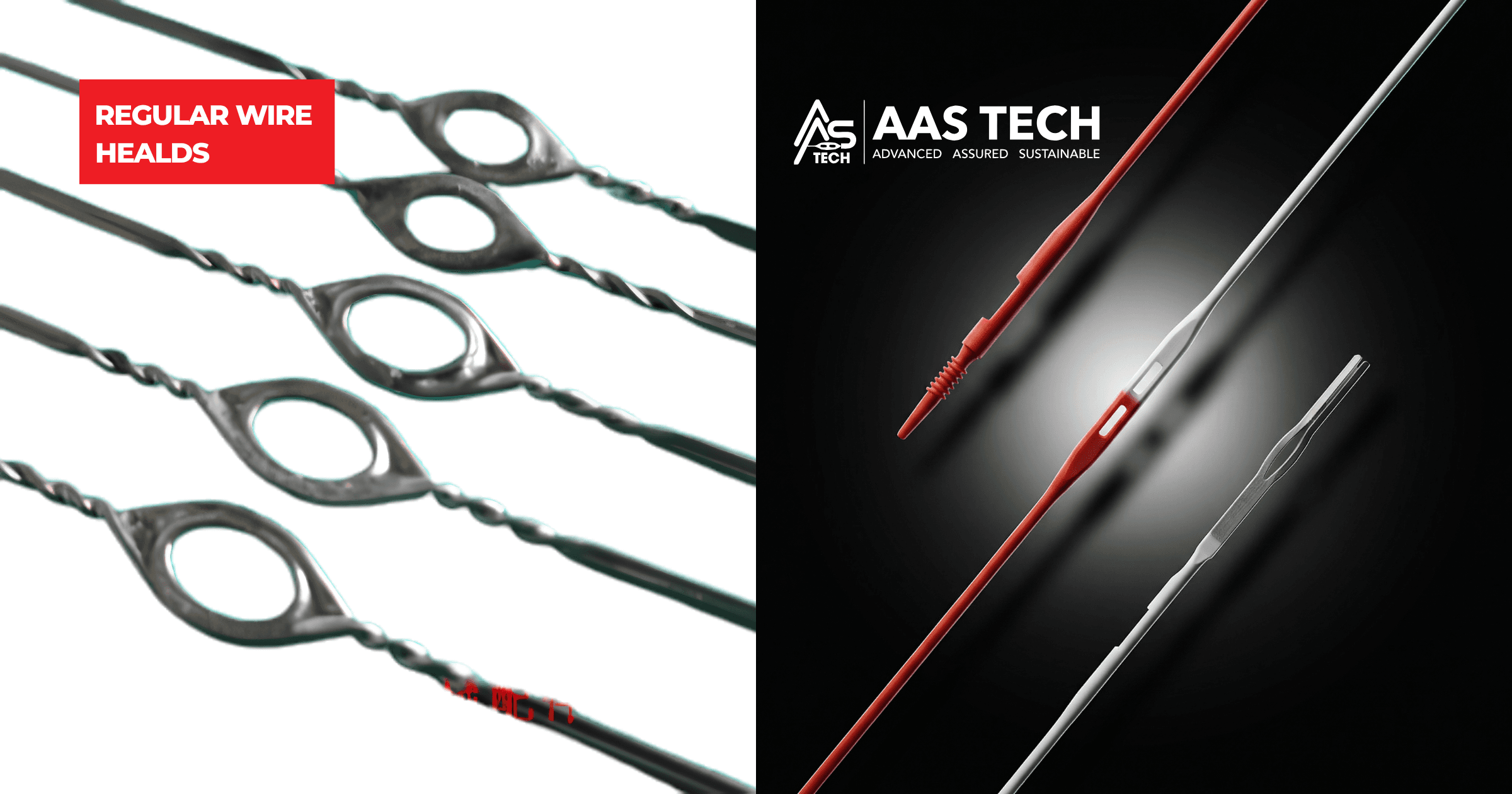
AAS Tech wire healds resolve this trade-off through dual-material construction — a structural core material selected for strength and fatigue resistance, combined with a contact-zone material selected for its lubrication and surface interaction properties. This approach decouples the two engineering requirements, allowing each to be optimised independently without compromise.
Material 1 provides structural strength and endurance: maintaining dimensional stability under high-tension conditions, resisting fatigue under the millions of cyclic loads applied per day, and ensuring the heald maintains its designed geometry throughout its service life.
Material 2 provides optimal lubrication and smoothness: reducing the friction coefficient at the yarn contact point, maintaining consistent surface properties across the full service life, and eliminating the surface degradation that causes conventional healds' friction performance to deteriorate over time.
“Dual-material construction is not a manufacturing complexity — it is an engineering decision that refuses to accept the performance ceiling imposed by single-material design. Strength and lubrication are not mutually exclusive. They are both achievable, simultaneously, in the same component.”
— AAS Tech Engineering Team
Continuous Improvement in Yarn Efficiency
The combination of structural integrity and surface lubricity in AAS Tech's dual-material healds produces measurable improvements in yarn efficiency across extended production runs. Mills report reduced yarn tension variance, lower breakage rates at constant loom speeds, and the ability to increase operating speeds without proportionally increasing breakage frequency — outcomes that single-material heald designs cannot reliably deliver.
For more information, contact info@aastech.co.
Related Articles
Stay Ahead of the Industry
Subscribe for engineering insights, performance strategies, and AAS Tech innovations delivered to your inbox.