
AAS Flat Heald: A Revolution in Yarn Movement
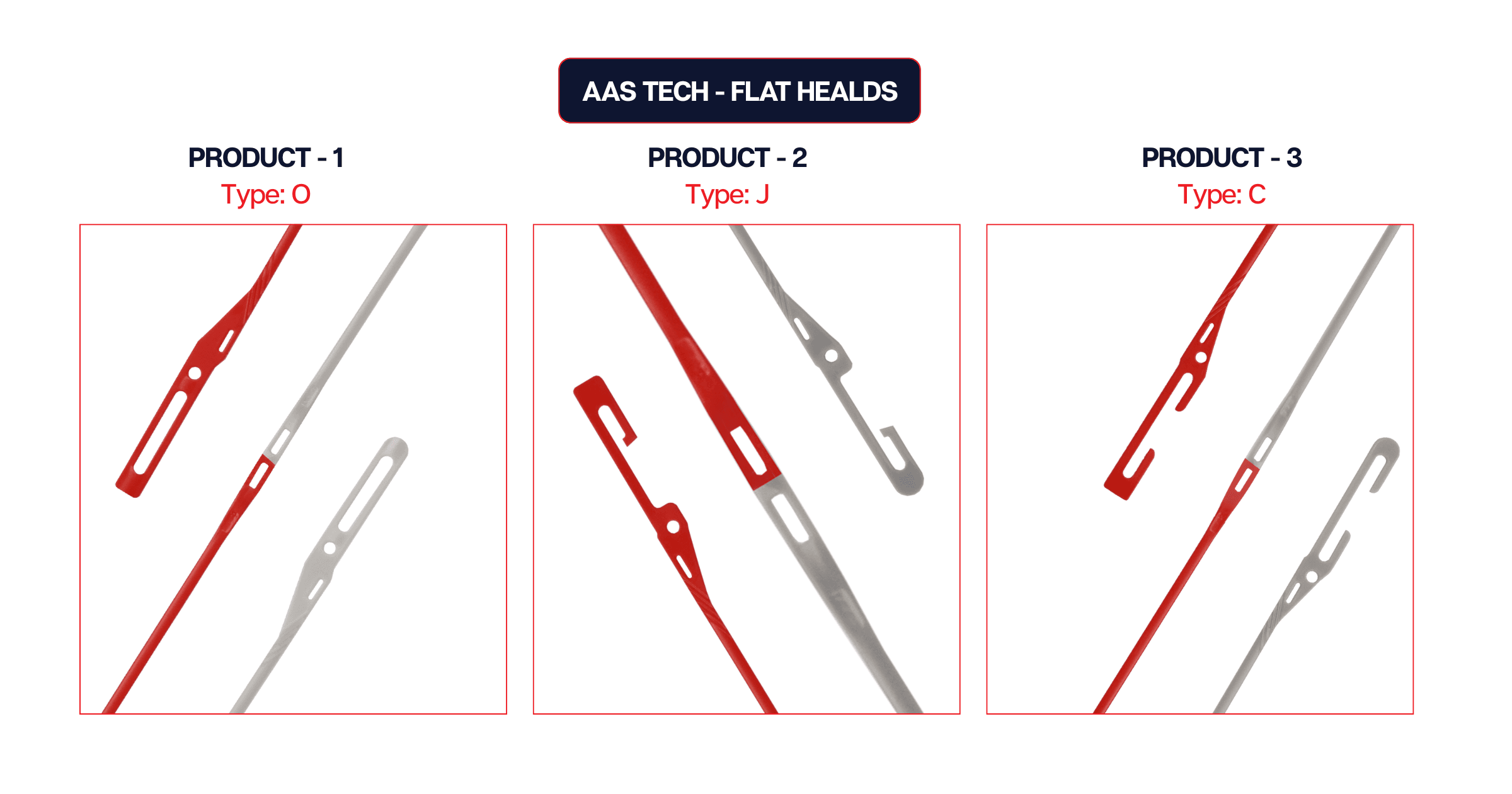
The geometry of a heald eye determines everything about how yarn interacts with the weaving system. Conventional round-wire heald eyes create a narrow contact arc that concentrates force on a small section of the yarn cross-section. AAS Tech's flat heald design replaces this contact geometry with a surface-interaction system that distributes force more evenly, reduces peak contact stress, and enables smoother yarn movement across the full range of loom operating speeds.
Three-Breakpoint Contact System
AAS flat healds utilise a unique three-breakpoint contact geometry that guides yarn movement through the shed without the sharp angle changes characteristic of conventional heald eye designs. Each breakpoint provides a controlled surface contact that holds the yarn in position while allowing it to move freely in the direction of travel. The result is a heald that maintains consistent contact pressure without creating the gripping effect that drives friction-induced yarn damage in traditional designs.
Breakout Detection Technology
AAS flat healds incorporate Shape Recognition Detection Technology (SRDT) — a structural design principle that enables the heald to detect and respond to breakouts during the weaving process. The flat heald geometry allows the system to track yarn movement and identify thread breaks more rapidly, reducing the propagation of breakouts before they trigger cascade failures across adjacent yarn positions. This makes it possible to detect broken thread and miscounted yarn early, preventing minor incidents from developing into major production interruptions.
“The flat heald does not just reduce friction — it changes the relationship between the yarn and the loom. It is a contact geometry that respects the yarn's mechanical properties rather than working against them.”
— AAS Tech Engineering Team
Consistent Contact Points
Unlike conventional heald designs where the contact geometry varies with heald wear and yarn tension fluctuations, AAS flat healds maintain consistent contact points across their operational lifespan. This consistency is critical for fabric quality: variations in contact geometry create variations in yarn tension, which manifest as fabric irregularities at the weave scale. AAS flat healds eliminate this source of variation by engineering consistency into the contact geometry rather than relying on controlled operating conditions to achieve it.
For more information, contact info@aastech.co.
Related Articles

Stay Ahead of the Industry
Subscribe for engineering insights, performance strategies, and AAS Tech innovations delivered to your inbox.